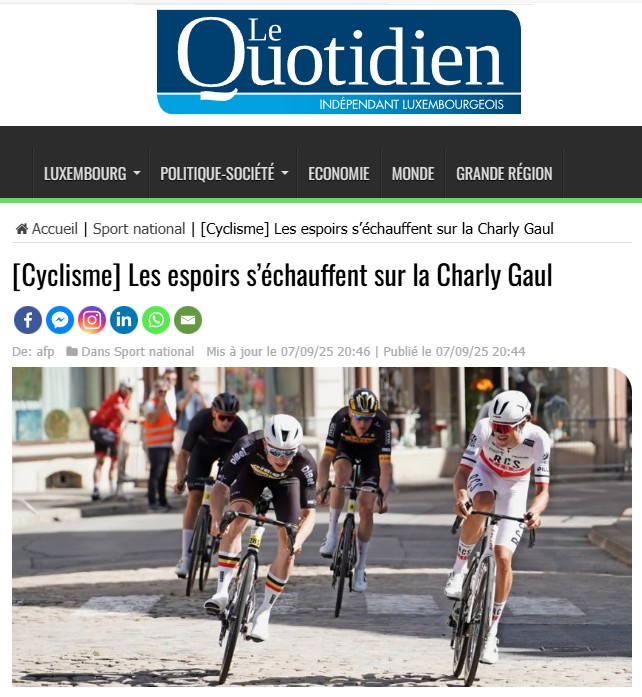
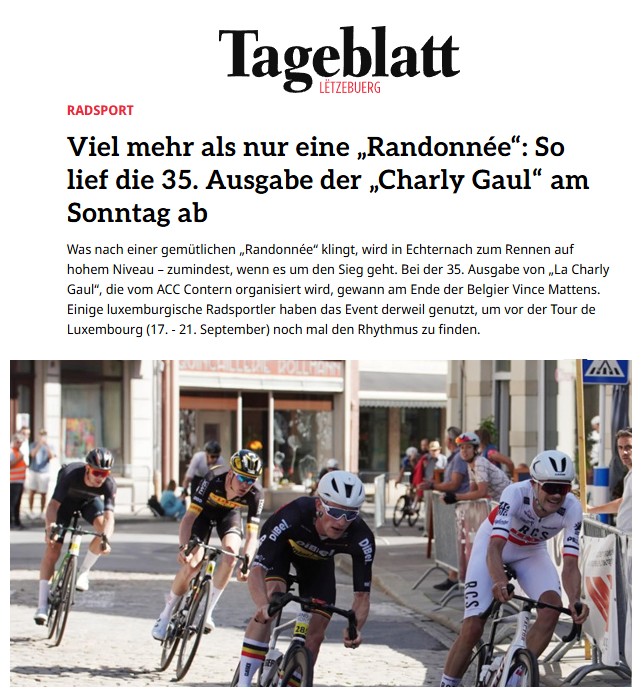
In this 35th edition of La Charly Gaul, we saw a very close duel between Vince Mattens and Michael Apers at the finish line for the victory in the long distance race. Mattens had launched his sprint very early and was comfortably positioned at the head of the leading group as they approached the white line. But Apers came back strongly from behind and pulled out from Mattens' wheel at the last moment to pass him on the line. Although Mattens was initially declared as winner by the electronic timing system and received the honours at the flowers ceremony, a review of the photos and video footage raised doubts, and we decided... not to decide anything between the two. It was virtually impossible to separate them and they will be ranked as joint winners in the history books. This is not an first, however: in 2005, Johan Villiger had the win in his pocket with two kilometres to go, before taking the wrong route and crossing the finish line finally behind Ben Gastauer. Given Villiger's lead at the time of the incident, the jury decided to declare both of them as winners at the time. On the shorter course, the decision was also made in a sprint this year, but without any doubt because, for the second year in a row, Belgium's Cyril Gustin was by far the fastest of a small group at the finish. There was no dispute either in the women's races where both Deborah Veerman and Tanja De Rond won with several minutes of advantage.
The weather was again very nice on this first Sunday in September in Echternach, with bright sunshine and temperatures a little too high to feel completely comfortable. But it was nothing compared to the heatwave of the previous year. The weather was almost perfect actually, encouraging 1,302 riders to line up at the Place du Marché in Echternach, making this 35th edition the second most popular in history after 2017 (1,360 participants). 654 contenders lined up for the long distance and 648 for the shorter course, making it almost fifty-fifty, whereas in recent years, riders on the long course have generally been slightly more in the majority. The good news is that there were 100 women at the start this year, more than ever before, which is very encouraging, especially as it is in the long distance (37 starters compared to 30 in 2023) that makes up for this record .
For the third year in a row, the winner of La Charly Gaul averaged close to 40 km/h over more than 150 kilometres of what can be described as a mountainous course. It is clear that the speed in the race has steadily increasing in recent years: while the average was between 35 and 38 km/h before the Covid years, it has never fallen below 39 km/h since the end of the pandemic (record in 2023 by Loïc Bettendorff with 40.4 km/h) The same is true for the shorter course, where Cyril Gustin completed the 100 less difficult kilometres this year with an average speed of over 41 km/h. The presence of quite a few licensed riders certainly has something to do with it. In the past, the few well-known names at the start were mostly former professionals such as Claudio Chiappucci and Kim Andersen back in the years. Now, more and more active riders are using our event to prepare for upcoming goals, given the general lack of competition in the country. As a proof, almost the complete national team who participated in the Tour de l'Avenir, including stage winner Mathieu Kockelmanm, was at the start this year as a last preparation for the Tour de Luxembourg, starting 10 days later. Last year, Christine Majerus made a remarkable appearance, and another twelve months earlier, superstar Arnaud De Lie had registered for the race in total anonymity before being spotted and recognised on the starting line. Although these riders rarely aim for victory, they are there to undergo intensive training and often adopt an aggressive approach that makes La Charly Gaul increasingly a real race with very high average speeds.
LA CHARLY GAUL A (145 km)
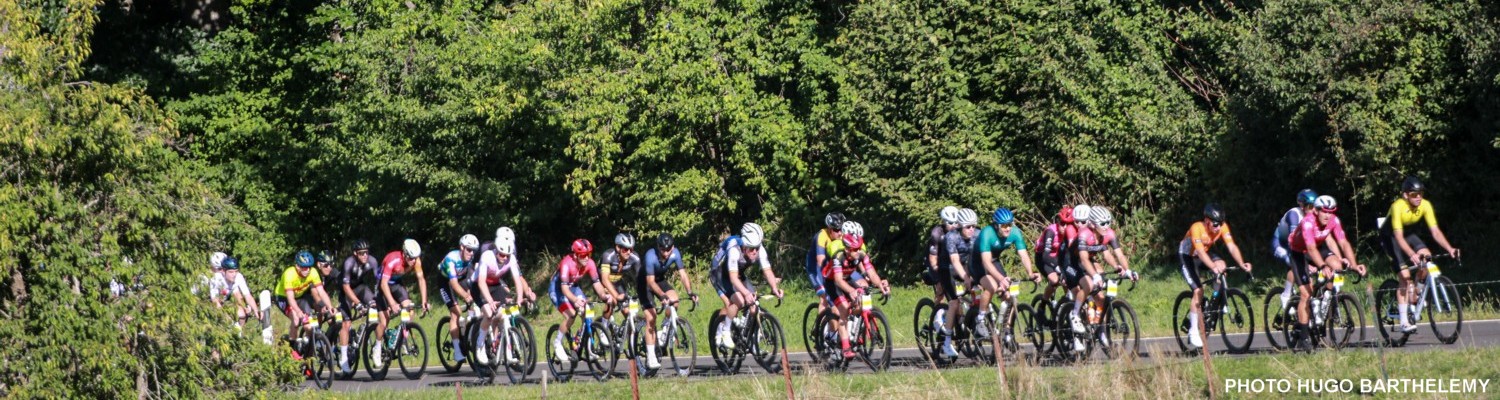
As a proof, Luxembourg's actual elite cyclo-cross champion and 2023 winner Loïc Bettendorff took the lead as soon as the race got underway on the climb of Berdorf, pulling away at the front with a good hundred metres' lead over a peloton led by Mathieu Kockelmann, Noé Ury and Mats Berns, with Pol Breser, Mil Morang and Vince Mattens also among the front riders. Two former La Charly Gaul winners, Ivan Centrone and Michael Apers, were a lot further back in the group, just like Anthony Spysschaert and, even more behind, Raphaël Kockelmann. All of them were forced to waste energy after that to get back to the front. On the descent into the Sûre valley, Bettendorff gained a 30-second lead over the front of the peloton and held on to the top spot alone for around 30 kilometres, before being caught shortly before the second climb of the day, the côte de Gralingen. After 50 kilometres of racing, on the Schlindermanderscheid climb, nine riders had established themselves at the front of the race, including Luxembourg's Loïc Bettendorff, Mathieu Kockelmann, Mats Berns and Mil Morang. Their lead over the chasing pack was minimal and soon Noé Ury also caught up with the leaders, followed by other competitors a little bit later.
On the hill of Broderbour, Vince Mattens was leading a relatively large group of around thirty riders ahead of Morang and Berns, a group that would soon split into several parts. While Mathieu Kockelmann chose to drop back to finish the race together with his brother Raphaël, eight riders found themselves at the front of the race. They included Loïc Bettendorff, multiple Luxembourg champion and riding in real life for Hrinkow Advarics, Mats Berns, member of VCU Schwenheim in Alsace and of the national U23 team, former Luxembourg junior champion Mil Morang, Michael Apers, winner of La Charly Gaul in 2019, Lilian Tetart, winner of this year's elite race in Einvaux in Meurthe-et-Moselle, Sten Van Gucht, third in the Belgian elite without contract time trial championships, Dutch rider Tijn Voerman and Belgian's Vince Mattens, second in this year's Gran Fondo des Vosges. Under the impression of the latter, on the Berdorf climb, Apers, Tetart and Voerman found themselves in difficulty for a moment, before being able to bridge up again to the front of the race.
With a minute and thirty seconds lead over their closest chasers, a group of ten riders including Pol Breser, Noé Ury, Max Valtey, Niels Merckx and Anthony Spiesschaert, two regulars at La Charly Gaul, the eight leaders stayed together for the rest of the race. Despite attacks from several sides and tactical manoeuvring, they gradually increased their lead: 2 minutes in Berbourg, then 3 minutes in the Sûre valley, heading for the finish line in Echternach. The decision was to be made in a sprint, a controversial sprint which, despite cameras and mobile phones video footage, failed to separate Vince Mattens and Michael Apers. The two riders were therefore classified joint first, a good length ahead of Mil Morang, the third man on the podium, and Loïc Bettendorff.
The women's race also had a reknowned name at the start: former European time trial champion Hannah Ludwig, a member of the Cofidis team, was the first woman at the top of the Berdorf climb, well positionned in the first men's peloton and already more than twenty seconds ahead of Dutch rider Ellen Van Doorn. Probably due to a mistake later in the race, the German found herself together with the competitors on the short course and therefore did not finish the race according to the rules. Behind Ludwig and Van Doorn, Deborah Veerman and Hanne Van Loock were very well placed at the beginning of the race, just like Luxembourg's Gwen Nothum and three-time race winner Ils Van der Moeren, all of them less than a minute behind the leaders. On the return from the big loop in Berdorf again, after a hundred kilometres of racing, Deborah Veerman had firmly established herself at the head of the women's race: just ten minutes behind Vince Mattens, who was leading the men's race, the Dutchwoman had a lead of no less than seven minutes over a prestigious trio consisting of Flemish Brabant champion Hanne Van Loock, former Luxembourg junior champion Gwen Nothum and former Gran Fondo world champion Ils Van der Moeren.
A few kilometres later, at the last food station, the gap was close to ten minutes and Veerman, a rider for the Velopro-Alphamotorhomes continental team who competed in this year's Gracia Orlova and Tour Féminin stage races in the Czech Republic, among others, had practically won the race. All she had to do was climb one last hill, then reach the finish line along the Sûre valley, well protected in her small peloton, which was the third men's group in the race. With an average speed of over 37 km/h, Deborah Veerman won the women's Charly Gaul, finishing 84th overall, just 16 minutes behind the winning men's duo. A good ten minutes later, Van Loock, Nothum and Van der Moeren battled it out for the podium places in a sprint finish, with Van der Moeren having to settle for fourth place overall behind her younger rivals, and victory in the C category for the more experienced riders. Special mention also goes to Luxembourg's Isabelle Hoffmann, who finished in the top 10 of the race, and to Ingird Haast, a former double winner who completed her one of ther numerous Charly Gaul participation with an average speed of around 30 kilometres per hour.
LA CHARLY GAUL B (99 km)
Sven Schmit and Philippe Sunnen were the two riders who got off with the best start in the shorter Charly Gaul, just behind the the top competitors in the long distance race. In Berdorf, after the first climb, Thomas Deruette was just a few seconds behind the duo, as were Rafael Marques, Peter Sina, Kuno Schulte, Mathias Petry, Oscar Franssen, Paulo Valente, Florain Gerard, Martin Haas and Jeff Mathay. The defending champion, however, Cyril Gustin, did not have his best start, finding himself at the back of the first group, which he just managed to catch up with at the top of the climb, and being already some twenty seconds behind the leaders. He threw himself into the descent and had to make a huge effort over the next few kilometres to get back to the front of the impressive leading group of 200 riders. After the two distances separated, just before the start of the Broderbour climb, around a hundred riders were still together at the front on the shorter course, but Broderbour and the Savelborn climb separated them soon.
Two riders attacked and took the lead for a while. Former pro continental riders Florian Gérard and Thomas Deruette, winner of a Grand-prix OST-Fenster among other races, gained a small lead over a group of around thirty pursuers. After fifty kilometres, on the second climb to Berdorf, the two riders only had a hundred-metre lead over a group of fifteen riders led by Luxembourg's Nic Zeimet ahead of Evan Baris and Philippe Sunnen. Slightly behind, Cyril Gustin fought to catch up with Peter Sina and Anthony Dovifat, among others. Unlike the other two, however, Dovifat never managed to get back to the front of the race, nor did Jules Pairoux, who chased not far behind. A little bit further back, the second group, consisting of around ten riders including Kuno Schulte, Gil Feller, Sandro Dostert, Oscar Franssen, Loris Arnould, Johannes Schnorbach, Pierre Goffinet and Jonathan Schouppe, passed the halfway point a good minute behind the leaders.
The two men at the front fought bravely for a few more kilometres, but were caught about 40 kilometres from the finish line. Vincent Renson and Carlos Calvo were dropped from the first group a little later, leaving 24 riders at the front of the race on the last climb out of Osweiler, struggling to seperate from each other. On the final descent towards the Sûre valley, seven riders gained a small advantage, but they were caught back a little further on, on the flat towards the finish line. Just like last year, the victory was decided in a sprint and, just like last year, Cyril Gustin won in style, ahead of Kleden Grosset and Martin Haas. Nic Zeimet finished just off the podium as the first Luxembourger.
In the women's race, defending champion Elisa Kockelmann got off to the best start and by far. Just behind the leading group of men, she was only about 30 seconds behind the race leaders and already a full minute ahead of Tanja De Rond and June Nothum. Next came Jolien Vleugels, Camen Burmeister and Melanie Boeur, two minutes behind, followed a few seconds later by Noa Holleman, Joy Ledeck, Martine Hoffmann, Anna Reiff and Victoria Baumgarten. However, Elisa Kockelmann was unable to maintain her lead in the category and was overtaken a little later on by Tanja De Rond.
The former national-team basketball player, who had already finished fourth in the 2024 edition of La Charly Gaul, managed to join a large group of more than twenty male runners and passed the halfway point less than ten minutes behind the leaders of the men's race. The Luxembourger was already more than five minutes ahead of three girls, Elisa Kockelmann, Anna Reiff and Carmen Burmeister, who were in a slightly smaller group. Of course, it was difficult for them to regain time again under these conditions. Jolien Vleugels followed a little over a minute further back, while June Nothum found herself battling alone with an 8-minute gap and was soon to be joined by the trio Victoria Baumgarten, Noa Holleman and Joy Ledeck.
Tanja de Rond finally won the women's race at La Charly Gaul B, finishing 105th overall with an average speed of 37 km/h and only a dozen minutes behind the male winner. She finished almost 6 minutes ahead of last year's winner, Elisa Kockelmann, and another Luxembourgish rider, Anna Reiff. The best in the slightly more experienced girls' category C, Germany's Carmen Burmeister finished fourth in the race, while June Nothum was the best young rider in 10th place, 16 minutes behind De Rond.